Home›Projects›Oil and Gas› Technology and innovationARTIFICIAL INTELLIGENCE LABORATORY / CBPF
RESEARCH, DEVELOPMENT AND INNOVATION

Artificial Intelligence
for Oil and Gas

Scientific knowledge and technological development for the challenges of reservoir characterization and subsurface exploration.

Through LAB-IA, the Brazilian Center for Research in Physics brings together expertise in artificial intelligence, physics, geosciences and high-performance computing to develop methods applied to the oil and gas industry.

Development and application

Technology and innovation

Computational methods, processing capacity and intellectual property built throughout the cooperation.

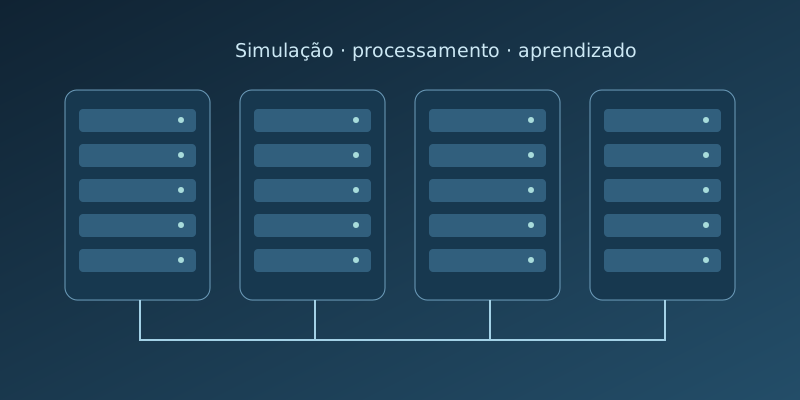
Scientific computing infrastructure
Conceptual illustration · no experimental data.

Technological output

Processing and interpretation

Routines to process borehole images, identify fractures and breakouts, segment rock images and extract quantitative attributes. The scientific documentation describes the methods and their application conditions.

Discover the well logs area →

Simulation for research

Computational tools to generate synthetic NMR signals and seismic data. Parameter control makes it possible to build training references and test physical and computational hypotheses.

View related dissertations →

Sci.Mind and multi-GPU computing

Infrastructure developed at CBPF for machine learning and scientific computing. It supports image processing, simulation and neural network training.

Discover Sci.Mind ↗
Recognition of the cooperation

Two Petrobras Inventor Awards

Recognitions that express the ability of CBPF and LAB-IA to turn scientific research into technological solutions for the oil and gas industry.

Petrobras Inventor Award · 2026

Artificial intelligence for carbonate rock classification

Technology developed by CBPF/LAB-IA in partnership with Cenpes/Petrobras to support the identification of pre-salt rocks. The award connects computer vision research to innovation applied to reservoir characterization.

The scientific trajectory includes the paper published in 2025 in Artificial Intelligence in Geosciences, followed by the development of the award-winning technological solution.

Institutional news · July 2, 2026 ↗
Petrobras Inventor Award · 2022

Automatic detection and characterization of breakouts

Recognition from the 2022 edition, announced on January 24, 2023, awarded to a borehole image processing technology developed in the cooperation between CBPF and Cenpes/Petrobras.

The contribution is part of the group's expertise in image interpretation, structure recognition and the development of computational methods for well evaluation.

Read the news on LAB-IA ↗
Intellectual property

Patent applications organized by year of Brazilian filing. For applications under secrecy, only the filing number and its secrecy status are shown, without identifying the subject or disclosing technical information.

BR 10 2025 024183-9 · Under secrecy period

Patent application under secrecy period

Patent application filed. Technical information unavailable during the secrecy period.

BR 10 2025 015220-8 · Under secrecy period

Patent application under secrecy period

Patent application filed. Technical information unavailable during the secrecy period.

BR 10 2021 021447-3 · A2 publication

Method for Automatic Characterization and Removal of Pad Artifacts in Ultrasonic Borehole Images

Detects and removes periodic pad marks in ultrasonic borehole images. Power spectrum analysis estimates the artifact frequency and guides the construction of a two-dimensional square wave model to filter the image, seeking to preserve geological and lithological information.

Filed: October 25, 2021 · published: May 9, 2023.

BR 10 2018 009637-0 · publication BR102018009637A2

Method for Automatic Detection and Characterization of Breakouts from Reservoir Borehole Images

Automatically identifies breakouts in ultrasonic transit time borehole images. The method segments candidate regions based on local noise, analyzes their geometry and recognizes breakout pairs, providing measurements of the detected structures to support image interpretation.

Filed: May 11, 2018 · published: November 26, 2019.

Expertise and new research fronts

Data engineering, scientific software, simulation and exploratory studies in quantum computing expand the group's research capacity.

Discover other expertise and emerging fronts →