Image interpretation and property inference
Acoustic and micro-resistivity logs record contrasts and structures on the borehole wall continuously along depth. Textural and geometric information complements conventional logging curves. The group investigates how this information can support structure identification, lithofacies classification and petrophysical property estimation, preserving the spatial context of the images and the meaning of the references used in the evaluation.
Detection and characterization of geological structures
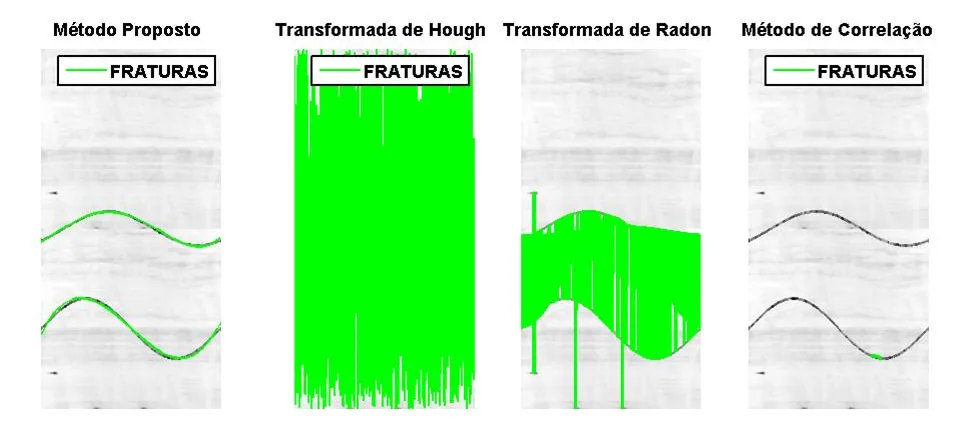
Identifying fractures requires recognizing patterns that may show low contrast, discontinuities and background interference. The group has experience developing detection and curve-fitting methods, evaluated against the Hough, Radon and correlation transforms. Experiments with synthetic images allow fracture contrast and geometry to be controlled; applications to real acoustic log images bring the evaluation closer to well interpretation conditions.
The line of work has evolved to include convolutional networks to locate and recognize fracture and breakout patterns in acoustic images. Fast-region approaches connect pattern recognition to the location of structures in the log. Lithofacies classification with residual networks is a complementary front, aimed at identifying lithological patterns along the well. [1] [2]
Porosity, permeability and uncertainty quantification
The group's expertise includes integrating ultrasonic and electrical images for lithofacies classification and petrophysical property regression. Stacked autoencoders extract representations from image windows, later used to estimate effective porosity and permeability. Data preparation accounts for eccentricity effects and periodic tool marks, linking image processing to the estimation of petrophysical curves. [3]
The group also applies Bayesian methods to estimate porosity and permeability simultaneously, along with predictive distributions. Instead of reducing each inference to a single value, the model makes it possible to study its spread and the degree of confidence associated with the prediction. Considering both properties jointly also preserves information about their correlation, making reliability assessment an explicit part of the regression problem. [4]
Reference quality and validity of interpretation
Estimated porosity and permeability must be interpreted in relation to the origin of the reference curves. In one of the approaches investigated, the regression references are derived from NMR using the Timur–Coates model. The evaluation therefore measures how well these curves are reproduced under the conditions studied. Comparison with independent laboratory measurements and transfer between wells are distinct dimensions of validation, important for relating computational performance to petrophysical use.
How much petrophysical information can be extracted from borehole images, and how can the uncertainty and validity conditions of that inference be represented?