Magnetic response in porous media
Nuclear magnetic resonance investigates fluids confined in the pore space through the evolution of magnetization. The observed response depends on fluid properties, confinement geometry, surface interactions and acquisition conditions. The group's work combines physical simulation and signal analysis to understand these contributions before associating a measured curve with a petrophysical property.
Digital rock and representative elementary volume
The group develops magnetic relaxation simulations directly on porous geometries obtained by microtomography of natural rocks. The evolution is computed using discrete random walks, making it possible to investigate how the signal changes as the simulated volume increases. The central problem is identifying a region large enough to represent the behavior of the system, preventing the response from being dominated by a local selection that poorly represents the heterogeneity.
The evaluation compares the stability of relaxation curves with the analysis of porosity and the surface-to-volume ratio. The existence of a representative volume is assessed for the sample and for the conditions of the numerical experiment. This approach provides a physical criterion for sizing simulations and interpreting the relationship between the digital structure and the macroscopic response. [1]
Internal gradients and relaxation regimes
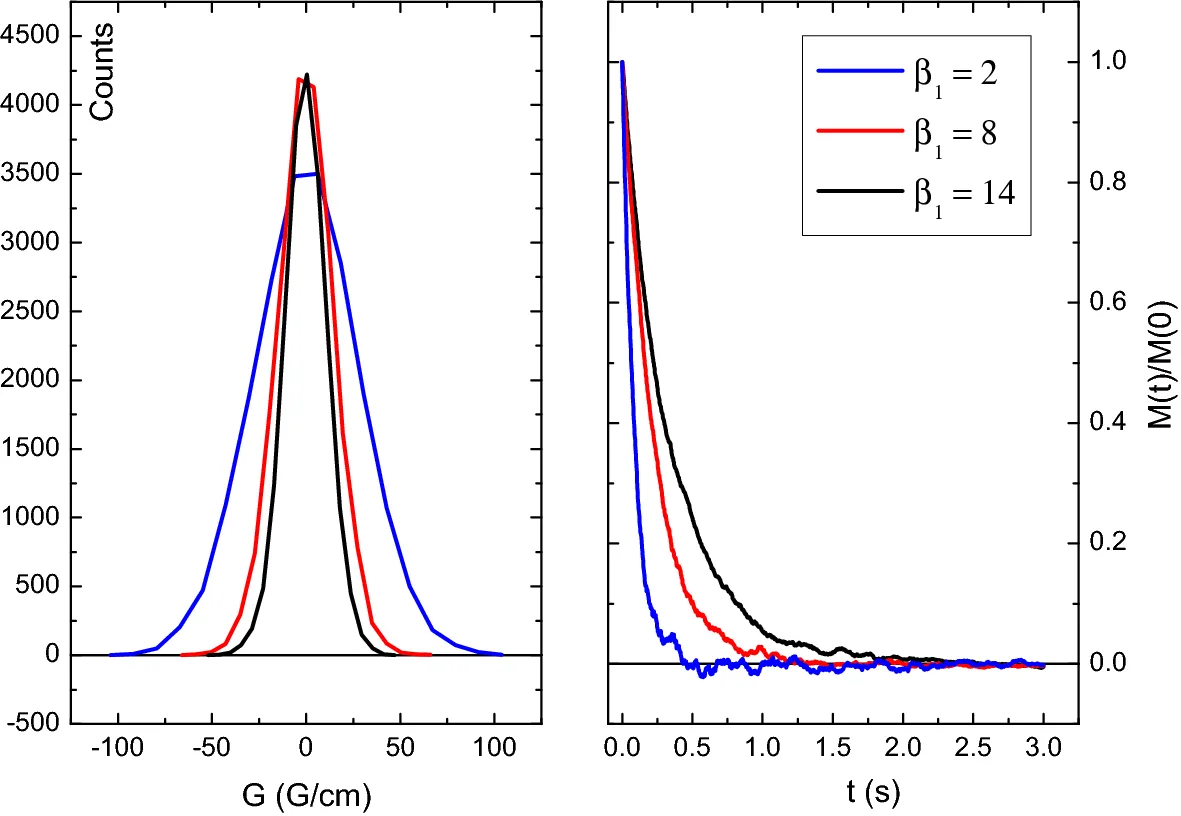
Simulation expertise includes introducing statistical distributions of magnetic inhomogeneity into real porous structures. Under the conditions investigated, local gradients dominate relaxation, while the surface contribution becomes irrelevant. Varying the echo spacing makes it possible to study the transition between behaviors: at short intervals, the response follows the free diffusion limit; at longer intervals, deviations appear that are associated with a pre-asymptotic localization regime. [2]
The figure relates internal gradient distributions to their respective time signals. It makes explicit that changes in the decay curve may reflect changes in the magnetic environment. Petrophysical interpretation must therefore consider which mechanisms and time scales dominate the experiment, without automatically attributing all signal variation to the pore size distribution.
Machine learning for oil saturation
The group investigates direct prediction of oil saturation from CPMG curves, comparing linear regression, XGBoost, multilayer perceptrons and one-dimensional convolutional networks. This work combines experiments with simulated signals and adaptation to laboratory measurements through pre-training, fine-tuning and data augmentation.
Saturation is treated as a continuous variable, distinct from the total porosity of the rock. The experimental design considers variations in the porous medium, echo spacing, fluid relaxation and noise. Transfer between simulation and laboratory is a central part of the research: the control offered by the synthetic model must be reconciled with the complexity of carbonates and real experimental conditions.
How can the effects of geometry, fluids and the magnetic environment be separated to infer petrophysical properties from the NMR signal?