Quantitative petrography and pore space architecture
Petrographic analysis describes the composition, texture and spatial organization of rock constituents. For reservoir characterization, the goal is to turn this information into reproducible measurements: grain size distribution, contact geometry, pore morphology and component proportions. The group's work connects geological interpretation to quantitative image processing, covering thin sections and three-dimensional representations from microtomography.
From segmentation to morphological characterization
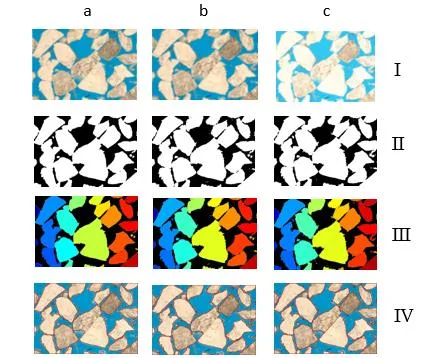
The group develops processing pipelines to segment and characterize grains in thin sections, combining filtering, k-means clustering and watershed separation. Comparing filters shows that pre-processing affects the recovered boundaries and, consequently, the extracted measurements. After segmentation, descriptors of area, perimeter, convex hull and best-fit ellipse make it possible to study grain size and shape. Application to sandstone thin sections allows the relationship between segmentation and the resulting morphological descriptors to be evaluated. [1]
This expertise includes unsupervised segmentation strategies that combine noise reduction, region-based image processing and convolutional networks, followed by watershed to recover contours. Transferring initialization parameters between regions seeks to keep processing consistent. The resulting grain size classification is compared with thin sections produced in controlled laboratory experiments, reducing dependence on large previously annotated datasets. [2]
Carbonate classification and expert models
In carbonates, textural heterogeneity and variability between wells make lithological classification a generalization problem. The group's work investigates computer vision and deep learning to identify classes in thin sections from pre-salt reservoirs. The group investigates one-vs-all expert classifiers and hyperparameter selection with AutoKeras, comparing this decomposition with multiclass models. The evaluation includes images from wells that were not used to build the models. [3]
Integration across scales and petrophysical meaning
In digital rock, microtomography extends the investigation to three-dimensional geometry. The work includes multiscale image matching, shape descriptors and phase segmentation. This representation provides the input geometry for porous media studies and physical response simulations. The link with NMR makes it possible to investigate which features of the pore structure are preserved in the macroscopic response, connecting image acquisition, characterization and modeling. [4] [5]
How can texture and geometry observed in images be turned into consistent rock descriptors while preserving physical interpretation and the ability to generalize across samples?