Lab-IA Researcher Participates in International Discussions on Artificial Intelligence Governance and Standardization at WAIC 2026
Researcher Clécio Roque de Bom, leader and scientific coordinator of the Laboratory of Artificial Intelligence for Physics (Lab-IA/CBPF) at the Brazilian Center for Research in Physics (CBPF) and an affiliated member of the Brazilian Academy of Sciences (ABC), participated in the World Artificial Intelligence Conference 2026 (WAIC), held in Shanghai, China, from July 17 to 20.
 View on Instagram
Researcher Clécio Roque de Bom, leader and scientific coordinator of the Laboratory of Artificial Intelligence for Physics (Lab-IA/CBPF) at the Brazilian Center for Research in Physics (CBPF) and an affiliated member of the Brazilian Academy of Sciences (ABC), participated in the World Artificial Intelligence Conference 2026 (WAIC), held in Shanghai, China, from July 17 to 20.
Considered an important international forum for discussions on artificial intelligence, WAIC 2026 brought together representatives from governments, international organizations, scientific institutions, and companies to discuss issues related to the development and use of AI, including governance, safety, technical standards, and international cooperation. The conference took place concurrently with the High-Level Meeting on Global AI Governance.
Clécio R. de Bom during WAIC 2026.
Brazilian Science in Discussions on International AI Standards
During the conference, Clécio participated as a keynote speaker in a forum dedicated to the international standardization of artificial intelligence. In his presentation, the researcher addressed the challenges involved in developing global standards for a rapidly evolving technology whose development is progressing unevenly across different countries.
Among the topics discussed were differences in scientific capacity, computing infrastructure, and access to advanced artificial intelligence models. In this context, establishing international standards involves not only technical issues but also challenges related to scientific cooperation and reducing inequalities in access to new technologies.
The discussion was part of a broader agenda on the responsible development of artificial intelligence. WAIC featured participation from the United Nations Industrial Development Organization (UNIDO), which promoted discussions on responsible AI governance, industrial development, capacity building, and expanding access to technologies.
During the event, the researcher also participated in the inauguration of the Global Industrial AI Ecosystem Network, an initiative aimed at fostering international collaboration between research, technological development, and industrial applications of artificial intelligence, with the participation of UNIDO.
Cooperation Between Brazil and China
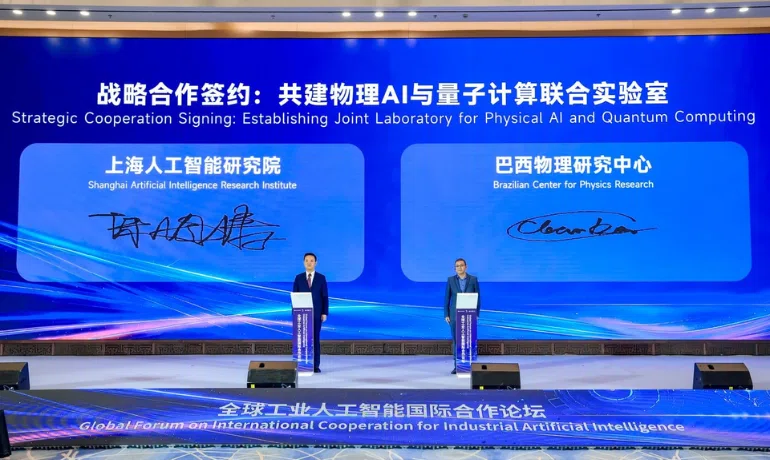
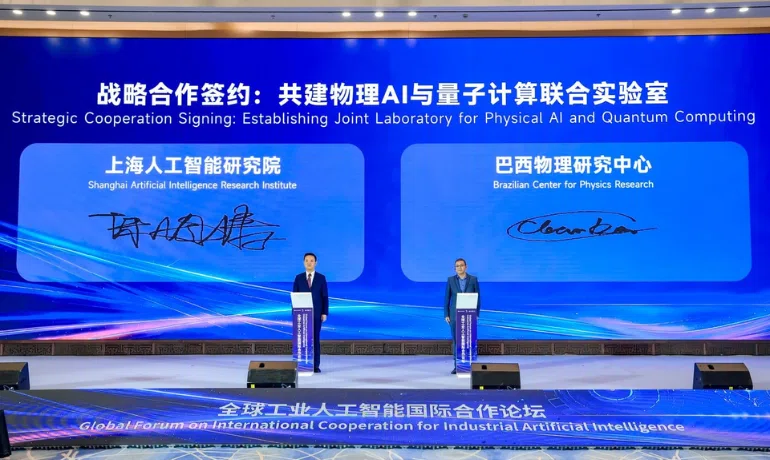
Participation in WAIC also contributed to advancing discussions on scientific cooperation between CBPF and the Shanghai Artificial Intelligence Research Institute (SAIRI), a Chinese institution dedicated to artificial intelligence research and to integrating science, technological development, and industrial applications.
The initiative opens up opportunities for joint projects in artificial intelligence applied to science, knowledge sharing, and closer collaboration between Brazilian and Chinese researchers.
The cooperation also directly aligns with the work of Lab-IA, which conducts research at the intersection of physics, artificial intelligence, and scientific computing, with applications in areas such as astrophysics, cosmology, gravitational waves, and geophysics.
AI, Science, and Challenges for the Future
In addition to discussions on standards and international cooperation, participation in WAIC brought issues related to access to computing infrastructure and artificial intelligence models to the forefront of the debate.
In an interview with China Media Group, the researcher emphasized the importance of international scientific cooperation, human oversight of AI systems, and expanding access to AI models and computing resources, particularly for countries that still have more limited technological capacity.
Brazilian participation in the conference also included Esther Dweck, Minister of Management and Innovation in Public Services, who attended WAIC and the international discussions held in Shanghai.
Governance, technological standards, computing infrastructure, and scientific cooperation are increasingly important issues in determining how artificial intelligence will be developed and used in the coming years. The participation of Brazilian researchers in international forums helps ensure that the country keeps pace with advances in AI and takes part in discussions that will shape the scientific, technological, and international cooperation pathways of the field.