2026 Nobel Prize in Physics: How Neutrinos Opened a New Window into the Universe — and What AI Has to Do with It
What can be discovered by a particle that passes through the Earth leaving virtually no trace? The answer lies at the heart of the work that earned particle physicist icecube.wisc.edu the 2026 Nobel Prize in Physics.
 View on Instagram
What can be discovered by a particle that passes through the Earth leaving virtually no trace? The answer lies at the heart of the work that earned particle physicist the 2026 Nobel Prize in Physics.
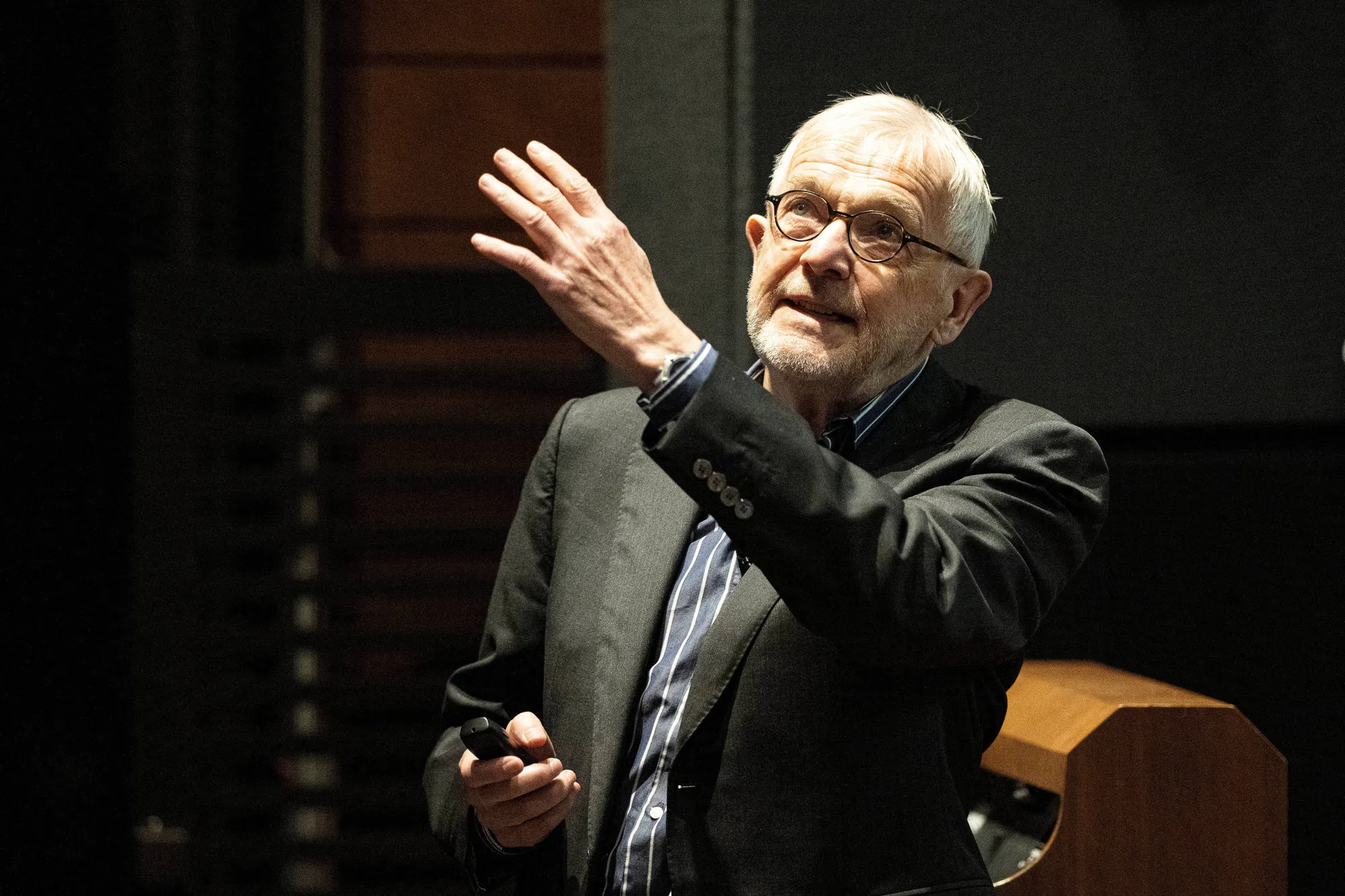
Francis Halzen, vencedor do prêmio Nobel de física de 2026, durante palestra na Universidade de Wisconsin–Madison, em Madison, Wisconsin, EUA. Crédito: Bryce Richter/UW-Madison.
The Royal Swedish Academy of Sciences awarded Halzen the prize for his contributions to theand the discovery of high-energy neutrinos of astrophysical origin. The recognition highlights an important transformation in astronomy: beyond light, scientists have begun using neutrinos as messengers to investigate the universe.
And this story also involves artificial intelligence. Although AI is not the reason for the award, machine learning techniques are already part of the tools used by the IceCube Collaboration to analyze signals recorded by the detector and reconstruct the properties of neutrinos.
Particles That Pass Through Matter
Neutrinos are among the most abundant particles in the universe. They are electrically neutral and interact very little with matter. Billions of these particles pass through our bodies at any given moment without us noticing.
This characteristic, however, poses a major challenge for physicists. Precisely because neutrinos interact so little, detecting them is extremely difficult.
At the same time, this apparent disadvantage is what makes these particles so valuable to astronomy. Because they interact only weakly with matter and are not deflected by magnetic fields in the same way as charged particles, neutrinos can travel enormous distances while carrying information about the environments in which they were produced.
Astrophysical neutrinos can therefore act as messengers of extreme phenomena occurring throughout the universe.
A Telescope Built in Ice
It was to capture these messengers that IceCube was created. Conceived from a proposal by Halzen to use Antarctic ice as a detection medium, the observatory occupies about 1 km³ of ice at the South Pole. Its optical sensors are distributed throughout the ice, searching for the flashes of light produced when secondary particles resulting from a neutrino interaction pass through the detector.
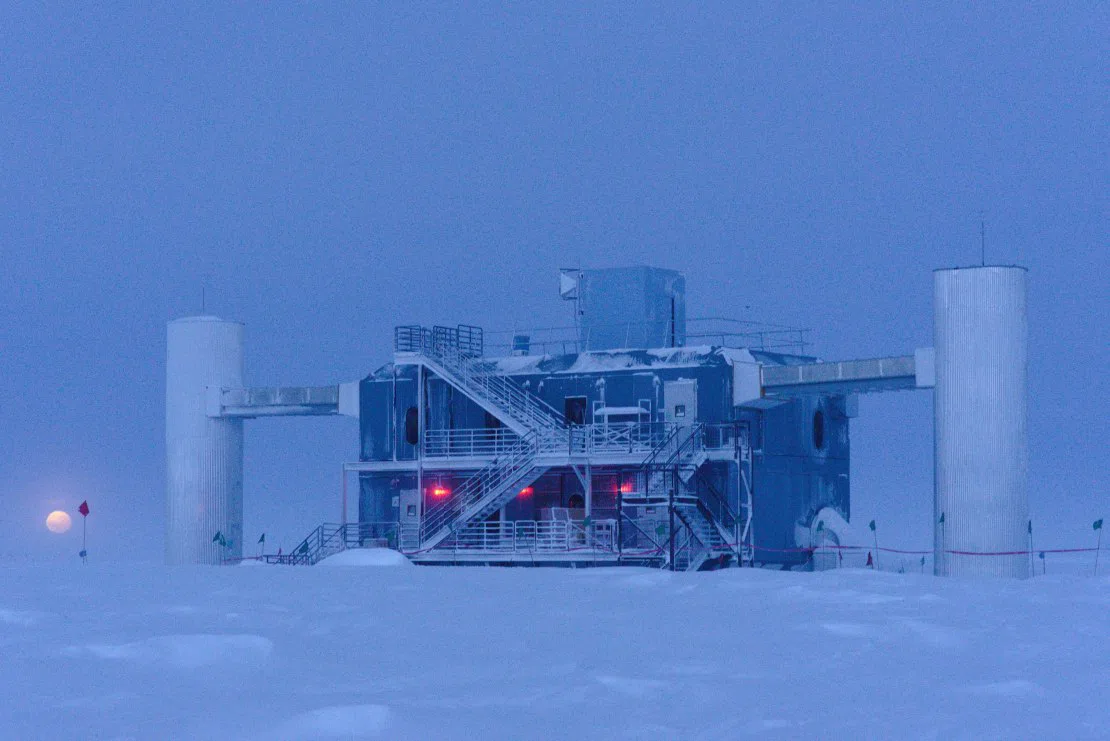
Moon rising next to the IceCube Laboratory at the South Pole at twilight. Credit: Alicia Fattorini, IceCube/NSF.
When a neutrino interacts with an ice molecule, it can produce particles that, in turn, emit a bluish light. This light is recorded by IceCube’s optical sensors.
From the pattern, timing, and distribution of these signals, researchers can reconstruct information about the event that occurred in the ice, including the direction from which the neutrino arrived and its associated energy. The result is a kind of telescope that does not observe the universe through light, but through particles.
Why the South Pole?
The choice of location is not merely a matter of geography. To detect a particle that interacts as weakly as a neutrino, it is necessary to observe a gigantic volume of matter, and the deep Antarctic ice provides a natural medium that can be instrumented with thousands of sensors.
IceCube’s infrastructure makes it possible to turn a vast amount of ice into a kilometer-scale detector capable of recording the rare events in which neutrinos interact with matter. This strategy enabled IceCube to achieve one of the major accomplishments recognized by the Nobel Prize: the detection of high-energy neutrinos of astrophysical origin.
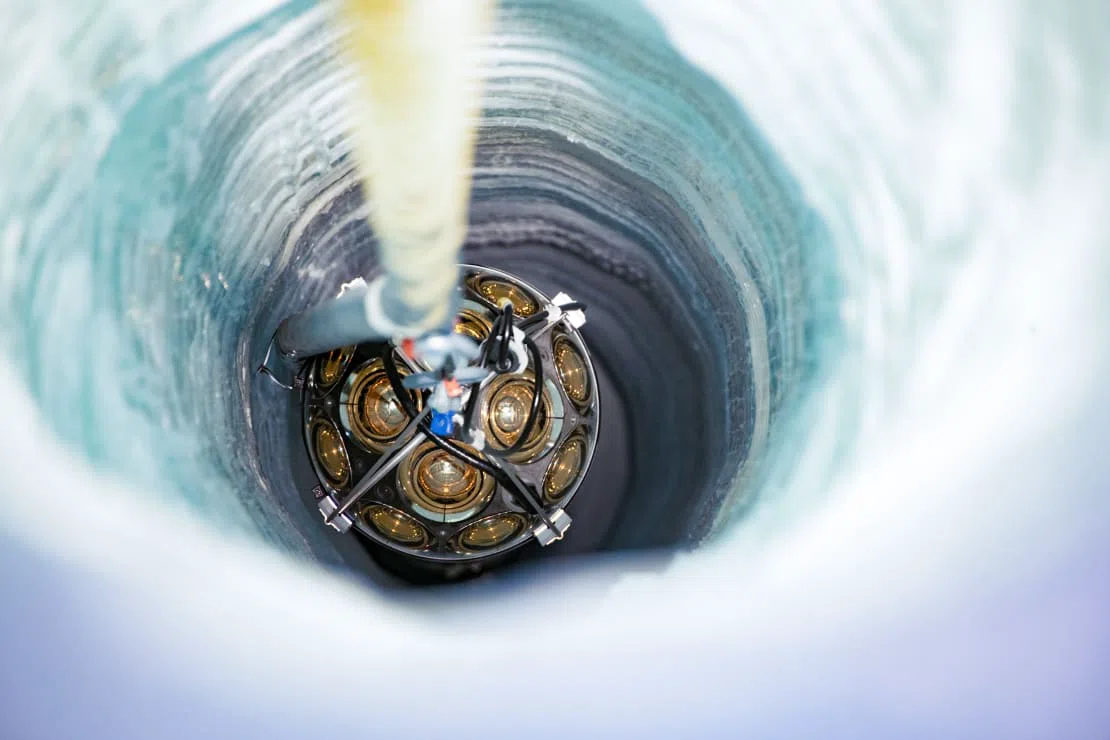
An multi-PMT digital optical module (mDOM) is lowered into a borehole. Credit: Yuya Makino, IceCube/NSF.
A New Way of Observing the Universe
The discovery represents the identification of a new class of particles coming from space and has opened up a new way of investigating the cosmos. For decades, astronomy has been built primarily on observations of electromagnetic radiation, from visible light to other parts of the spectrum. Neutrinos add a new source of information.
These particles can carry clues about phenomena and regions of the universe that are difficult to study through other means. As a result, so-called neutrino astronomy complements other forms of observation and contributes to an increasingly comprehensive view of the cosmos.
This advance is also related to so-called multi-messenger astronomy, which combines different types of signals to investigate the same cosmic phenomenon.
And Where Does Artificial Intelligence Come In?
To turn the signals recorded by IceCube into scientific information, researchers need to deal with complex data and a vast number of possibilities for each event.
This is where artificial intelligence and machine learning techniques come into play.
IceCube already uses convolutional neural networks (CNNs) to reconstruct the properties of neutrino events. In analyses of DeepCore, a more densely instrumented region of the detector, neural networks have been used to reconstruct low-energy events and improve the selection of neutrino candidates.
In a neutrino oscillation analysis, for example, CNNs were used to reconstruct properties of the interactions recorded by the detector. The dataset produced using this approach significantly increased the number of events available for analysis while maintaining high neutrino purity.
The advantage lies in neural networks’ ability to learn complex patterns present in the signals recorded by the sensors—patterns that can be difficult to model or process using conventional methods.
From CNNs to Transformers
The use of AI in IceCube did not stop with convolutional neural networks. In 2026, researchers from the collaboration presented a new method based on combining transformers and normalizing flows to estimate the direction from which neutrinos arrive.
Transformers are an artificial intelligence architecture that has gained significant attention in applications such as language processing, but their characteristics can also be leveraged for scientific problems involving complex data and relationships between different elements of an observation.
In the case of IceCube, the data recorded by the optical modules are processed by the transformer. The model then uses this information to estimate the probability distribution associated with the neutrino’s direction.
According to the IceCube Collaboration, the new method outperformed traditional reconstructions based on likelihood optimization, while being both faster and more accurate. The expectation is that methods of this kind will contribute to producing more precise neutrino sky maps and enable the identification of fainter fluxes.
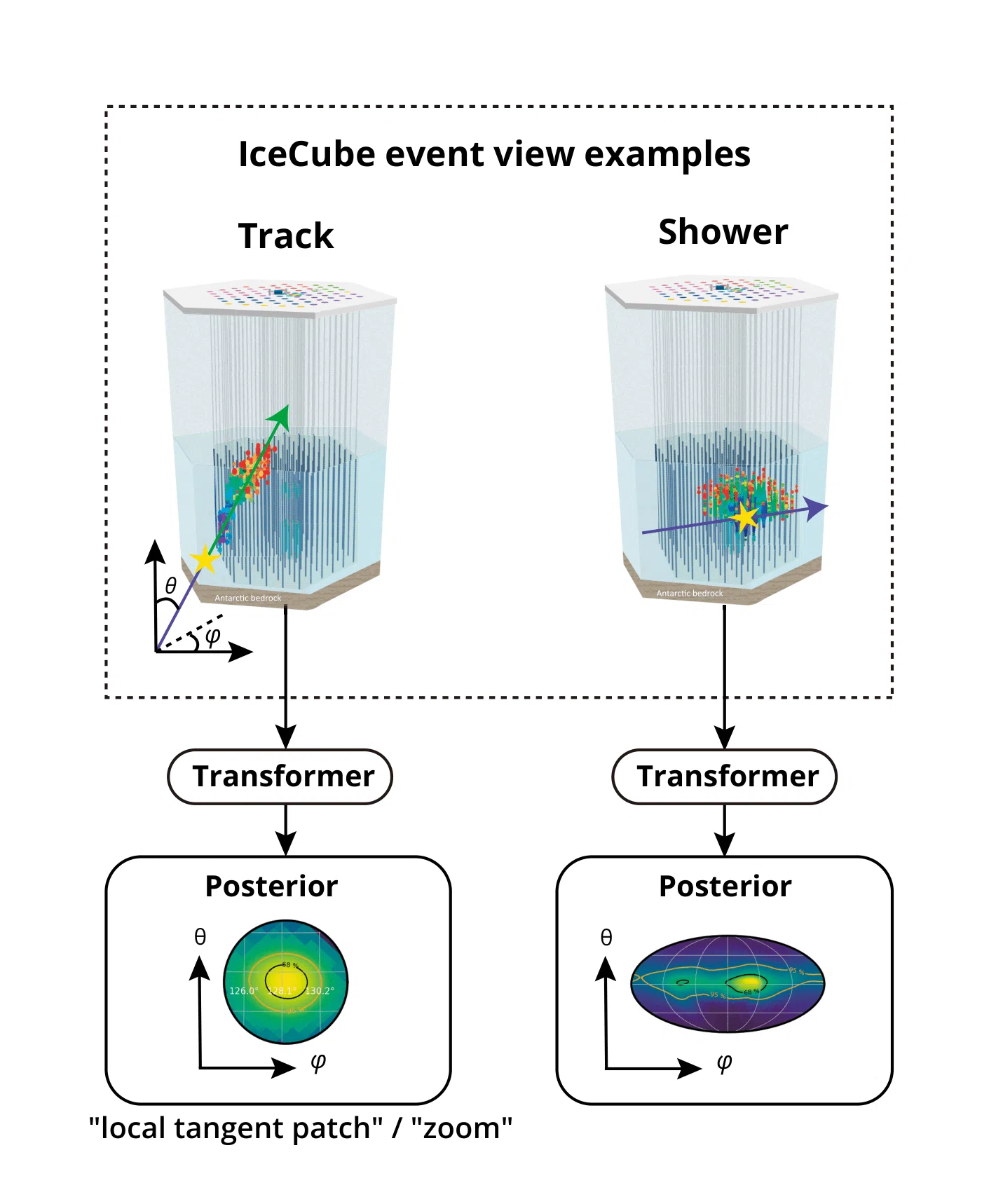
Visão geral da estimativa posterior neural amortizada baseada em Transformer na esfera. Os dados de fótons são coletados em módulos ópticos distribuídos hexagonalmente em um volume de um quilômetro cúbico e, posteriormente, codificados por meio de um Transformer. A cor dos módulos indica o tempo, onde o vermelho representa o início e o azul, o fim. O Transformer mapeia os dados de fótons dependentes do evento para os parâmetros de fluxo normalizador e, assim, codifica todas as distribuições posteriores para eventos semelhantes ao conjunto de dados de treinamento de uma só vez. Crédito: Colaboração IceCube
The observatory has transformed one cubic kilometer of ice into a vast scientific infrastructure, and its sensors record signals that need to be reconstructed, classified, and interpreted before they can be turned into knowledge about the universe. This shows that major discoveries depend not only on new instruments, but also on new ways of interpreting the data they produce.
The Nobel Prize awarded to Francis Halzen recognizes the creation of a new window for observing the universe. Artificial intelligence, in turn, helps expand that window, making it possible to analyze signals with greater speed, precision, and scale.