CBPF PhD Student and Lab-IA Member Receives Best Poster Award at the Advanced School in Applied Machine Learning, Held by ICTP
The PhD student at the Brazilian Center for Research in Physics (CBPF) and member of the Laboratory of Artificial Intelligence for Physics (Lab-IA), Phelipe Darc, received the Best Poster Award during his participation in the Advanced School in Applied Machine Learning: Uncertainty and Robustness of Deep Learning Models for Science.
 View on Instagram
The PhD student at the Brazilian Center for Research in Physics (CBPF) and member of the Laboratory of Artificial Intelligence for Physics (Lab-IA), Phelipe Darc, received the Best Poster Award during his participation in the Advanced School in Applied Machine Learning: Uncertainty and Robustness of Deep Learning Models for Science, held by the International Centre for Theoretical Physics (ICTP) in Trieste, Italy, from July 23 to 31, 2026.
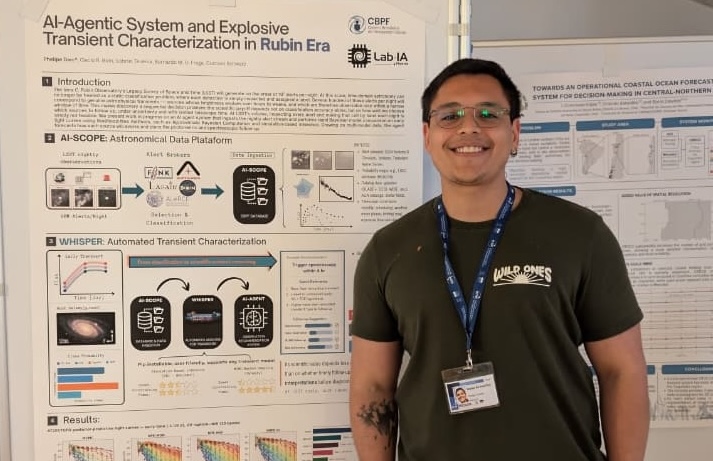
The award was given for his work, “Intelligent Agents and Physical Modeling of Transients in the Rubin Era,” a research project that proposes the use of artificial intelligence to assist in identifying scientifically interesting transient phenomena amid the enormous volume of data expected to be generated by the Vera C. Rubin Observatory.
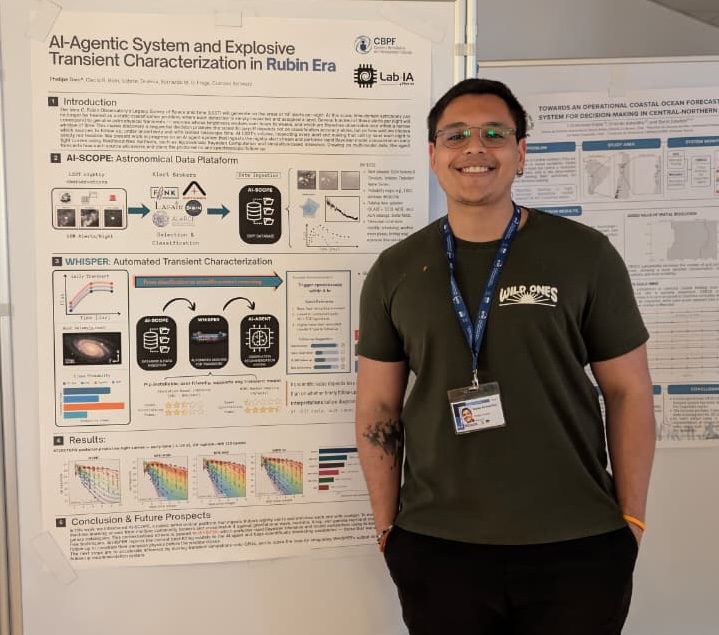
Phelipe Darc apresentando pôster do trabalho “Intelligent Agents and Physical Modeling of Transients in the Rubin Era”.
Créditos: arquivo pessoal
Artificial Intelligence to Handle Rubin’s Data Volume
The work addresses one of the challenges facing astronomy with the start of scientific operations at the Vera C. Rubin Observatory and the Legacy Survey of Space and Time (LSST): the enormous number of events being detected by the survey every night.
Rubin repeatedly observes large regions of the sky, making it possible to identify objects and phenomena that change over time. Among them are so-called transients, astronomical events that can exhibit rapid variations and, in some cases, require follow-up observations to study their characteristics.
With a very large number of candidates being identified, it becomes necessary to develop methods to assist researchers in selecting the most relevant events for each scientific objective. By combining artificial intelligence agent systems with Bayesian model comparison, Phelipe’s work focuses on developing a recommendation system capable of evaluating transient candidates and indicating which are most interesting according to the user and the scientific case under consideration.
The proposal thus seeks to help the astronomical community decide which events should receive infrared, optical, and spectroscopic follow-up observations, especially in situations where speed is critical.
“Every night, we risk missing interesting transients that could help us understand our Universe and the physical mechanisms driving these explosions. This happens because of the large amount of data we need to analyze and the number of observations we need to propose. That is exactly why we need intelligent observation recommendation systems: to help the astronomical community make full use of telescope capabilities and discover rare supernovae and other explosive events while they are still in their rise phase,” Phelipe explains.
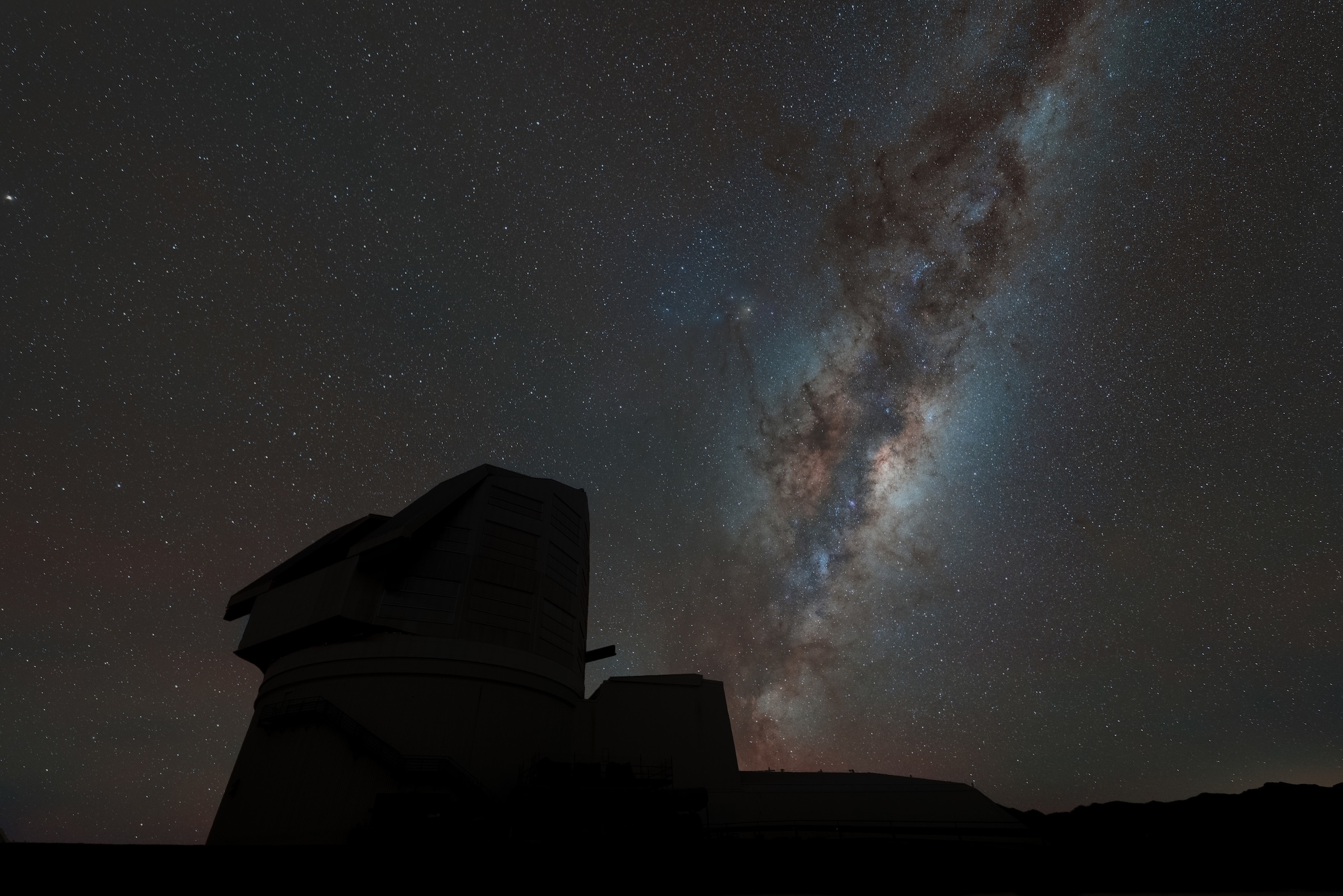
The night sky dazzles over Rubin Observatory.
Créditos: Vera C. Rubin Observatory
AI and the New Challenges of Astronomy
The research presented at ICTP addresses an increasingly relevant question in astronomy: how to transform large volumes of observational data into useful scientific information.
In the case of transients, it is necessary to identify events and determine which ones are most relevant to different scientific questions, deciding which should be followed up with other instruments.
Phelipe’s proposal seeks to contribute to this process by combining AI agents, physical modeling, and Bayesian methods to create a recommendation tool designed to support decisions related to the follow-up of transient phenomena.
Participating in the school also provided an opportunity to discuss these ideas with researchers working on different applications of machine learning in science.
The Best Poster Award recognizes the research presented by the PhD student in the investigation of new applications of artificial intelligence to scientific problems, particularly in the face of the challenges brought by the new generation of astronomical surveys.
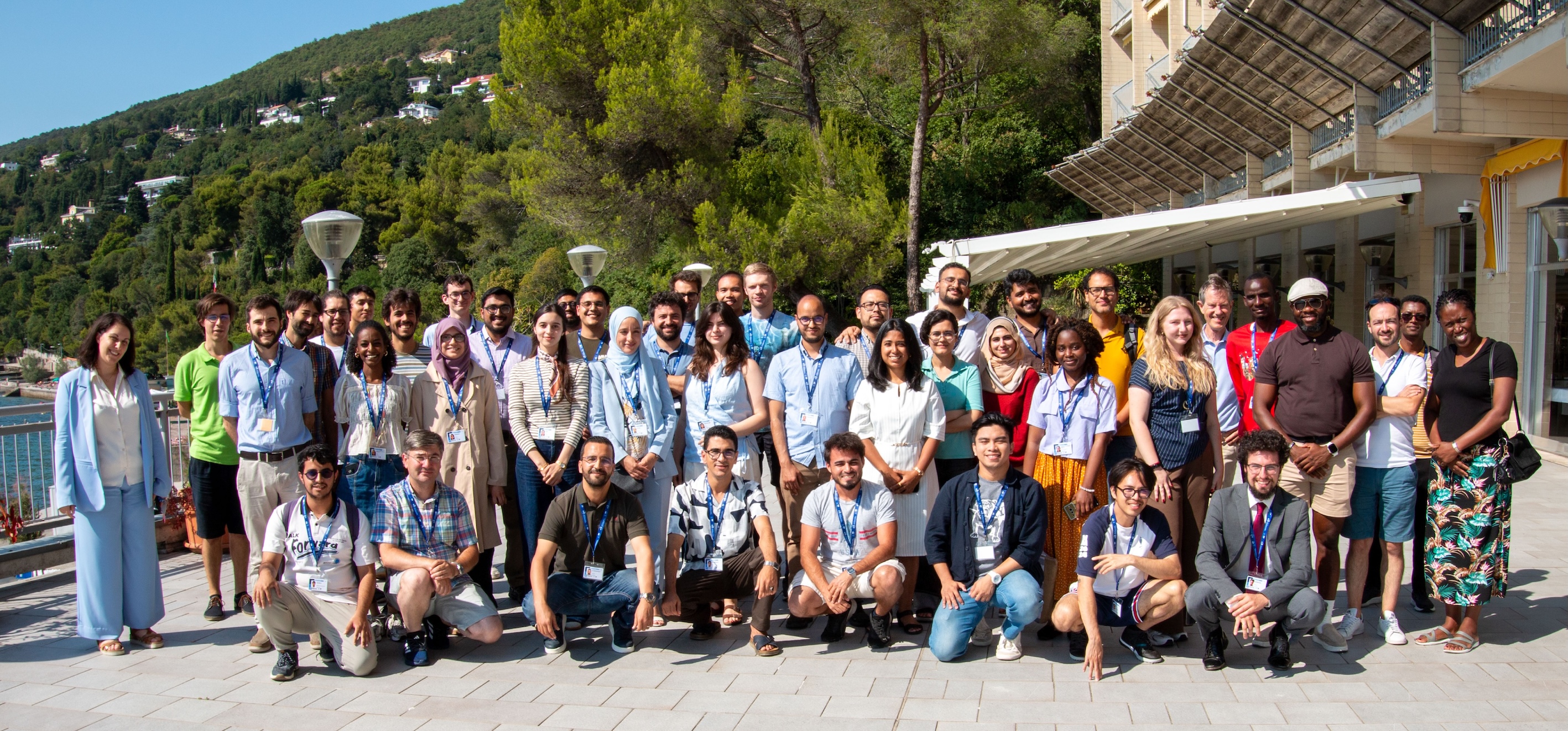
Foto de grupo da Advanced School in Applied Machine Learning.
Créditos: ICTP.
A School Dedicated to Artificial Intelligence for Science
The Advanced School in Applied Machine Learning: Uncertainty and Robustness of Deep Learning Models for Science was organized by ICTP in partnership with SISSA/TSDS and AREA. The event was primarily aimed at PhD students and early-career researchers, with the goal of introducing tools for the use of deep learning in scientific applications.
Topics covered included Scientific Deep Learning, uncertainty quantification in machine learning, simulation-based inference, and Bayesian neural networks. The program also highlighted scalability, sustainability, and the use of high-performance computing techniques to optimize machine learning pipelines.
The event brought together participants from different fields and featured speakers from research institutions, universities, and technology companies. The program included lectures, tutorials, participant presentations, and a poster session.