Pesquisador do Lab-IA conquista o 1º lugar no Prêmio Clóvis Caesar Gonzaga de Mestrado
O pesquisador Felipe de Campos Pinto Sinnecker, integrante do Laboratório de Inteligência Artificial para a Física (Lab-IA/CBPF), foi o vencedor do Prêmio Clóvis Caesar Gonzaga, conquistando o 1º lugar com sua dissertação "On a geometric graph-covering problem related to optimal safety-landing-site location".
 Ver no Instagram
Felipe de Campos Pinto Sinnecker, a fellow at the Artificial Intelligence for Physics Laboratory (Lab-IA/CBPF), won the Clóvis Caesar Gonzaga Master's Award, earning first place for his dissertation, "On a Geometric Graph-Covering Problem Related to Optimal Safety-Landing-Site Location."
Awarded to outstanding work in the fields of Applied Mathematics and Computer Science, the prize recognizes master's dissertations that stand out for their originality, rigorous mathematical foundation, methodological excellence, and potential scientific impact.
The dissertation was developed within the Graduate Program in Systems Engineering and Computer Science at the Federal University of Rio de Janeiro (UFRJ), under the supervision of Professor Márcia Helena Costa Fampa, in collaboration with Professors Jon Lee (University of Michigan, United States) and Claudia D'Ambrosio (École Polytechnique, France).
A New Optimization Problem with Real-World Applications
The research introduces a novel geometric graph-covering problem, motivated by the definition of Safety Landing Sites (SLS) — safe landing locations within urban air mobility transportation networks.
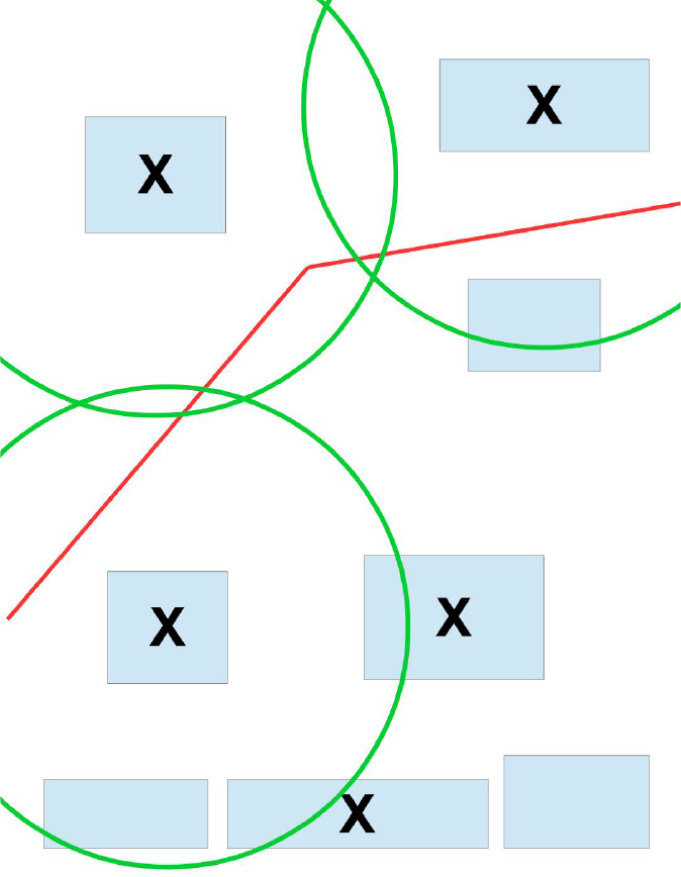
As new air mobility technologies continue to advance, there is a growing need for mathematical tools capable of supporting strategic decisions related to the safety and planning of these operations. In this context, the research proposes optimization models that identify the best locations for landing sites while satisfying spatial coverage and operational efficiency requirements.
Although inspired by challenges in urban air mobility, the proposed problem has broader applications in areas involving optimal facility location, network coverage, and logistics planning.
New Mathematical Models and Computational Methods
To solve the problem, Felipe developed two mathematical formulations.
The first considers a finite set of candidate locations and models the problem as a binary linear programming formulation based on the classical set covering framework.
The second extends this approach by considering convex regions as potential landing sites. It is formulated as a mixed-integer programming problem with second-order cone constraints, enabling the representation of scenarios that more closely resemble real-world applications.
In addition to the mathematical formulations, the research introduces a novel integer-variable fixing technique, called strong fixing, based on concepts from convex optimization duality.
To validate the proposed methodology, a complete computational pipeline was also developed for generating benchmark instances and conducting computational experiments.
Results with Strong Potential for Future Applications
The computational experiments showed that the strong fixing technique significantly reduces the size of integer programming problems when compared with traditional approaches such as reduced-cost fixing.
The results also demonstrated the potential of the proposed formulations for real-world geometric covering problems, opening new research opportunities in optimization, operations research, and computational intelligence.
“Receiving the Clóvis Caesar Gonzaga Award is a great honor. This recognition reflects all the effort and dedication invested in this research. I am deeply grateful to the professors who guided and supported me throughout this journey, as well as to Lab-IA, which provides the conditions necessary for us to continue developing cutting-edge research.” — Felipe Sinnecker
Interdisciplinary Research and International Collaboration
The research is the result of a collaboration among researchers from the Federal University of Rio de Janeiro (UFRJ), the University of Michigan (USA), and École Polytechnique (France), bringing together expertise in mathematical optimization, mathematical programming, and operations research.
This international collaboration combined theoretical foundations, methodological development, and computational experimentation to address a problem that remains largely unexplored in the scientific literature.
Reconhecimento à excelência científica
A conquista do Prêmio Clóvis Caesar Gonzaga representa um importante reconhecimento à qualidade da pesquisa desenvolvida por Felipe e reforça o papel do Lab-IA na formação de pesquisadores que atuam na interface entre matemática aplicada, inteligência artificial, computação científica e otimização.
Além das aplicações em problemas de engenharia e mobilidade, estudos como este contribuem para o desenvolvimento de novos algoritmos e metodologias capazes de apoiar a tomada de decisão em sistemas complexos, uma das principais áreas de atuação do laboratório.
O reconhecimento também evidencia a importância da colaboração entre universidades, centros de pesquisa e instituições internacionais para o avanço da ciência e da inovação, fortalecendo a produção científica brasileira em áreas estratégicas para o desenvolvimento tecnológico.
Saiba mais sobre esse trabalho aqui.