Uma rara e fundamental explosão e seu longo caminho de formação
Uma das explosões mais energéticas já observadas no universo está desafiando os modelos atuais da astronomia. O GRB 230307A, uma provável kilonova causada pela colisão de estrelas de nêutrons, ocorreu em uma posição extremamente incomum e pode ajudar cientistas a compreender melhor a origem de elementos pesados, ondas gravitacionais e a evolução do cosmos.
 Ver no Instagram
In March 2023, telescopes around the world recorded one of the most intense flashes of light ever observed in the universe. Named GRB 230307A, the phenomenon was classified as a gamma-ray burst — an extremely energetic explosion that lasts only a few minutes but releases an amount of energy comparable to that emitted by the Sun over billions of years. Analysis of the emitted light indicated that the event was most likely a kilonova: the glow produced by the collision of two neutron stars, ultradense remnants of massive stars that have already died. Besides being rare, these collisions are fundamental to the formation of heavy elements such as gold and platinum.
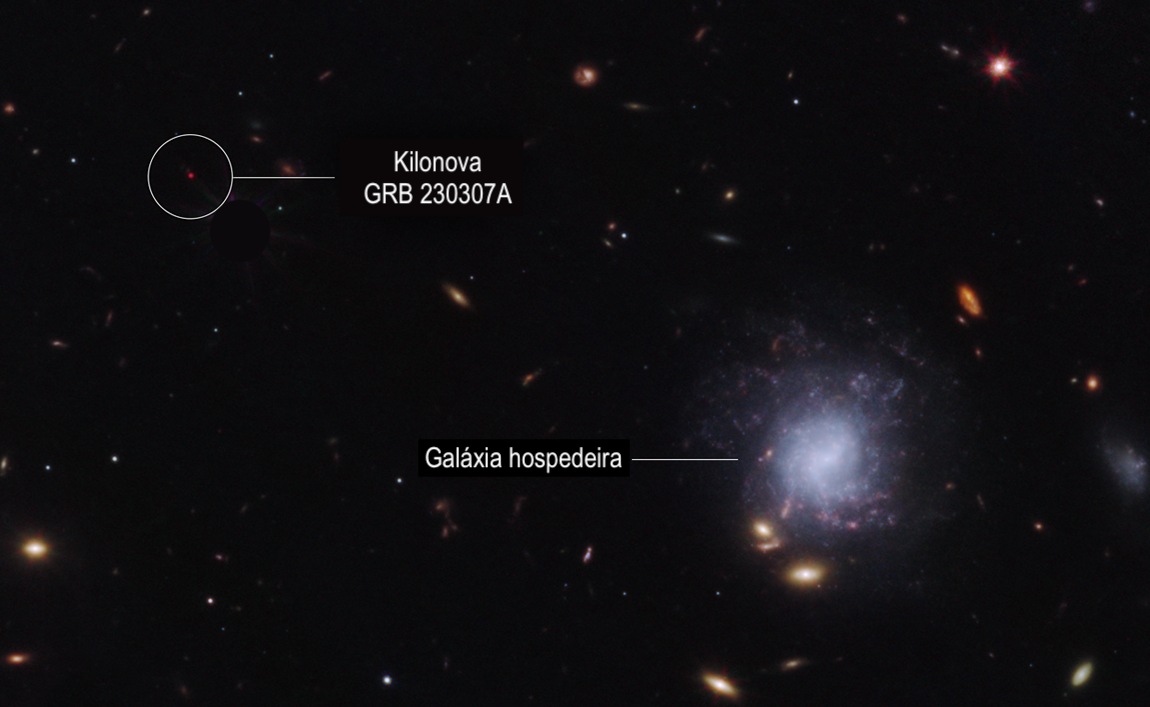
What intrigued astronomers and physicists, however, was not only the explosion itself, but also where it occurred: the kilonova was located about 130,000 light-years away from its host galaxy — a distance greater than the diameter of that galaxy’s stellar disk and comparable to the size of the Milky Way.
To investigate the origin of the event, an international collaboration — led by Brazilian researchers from the Centro Brasileiro de Pesquisas Físicas, Universidade Federal do Espírito Santo, and Universidade Federal do Rio de Janeiro — used data from the James Webb Space Telescope and the MUSE instrument at the European Southern Observatory in Chile.
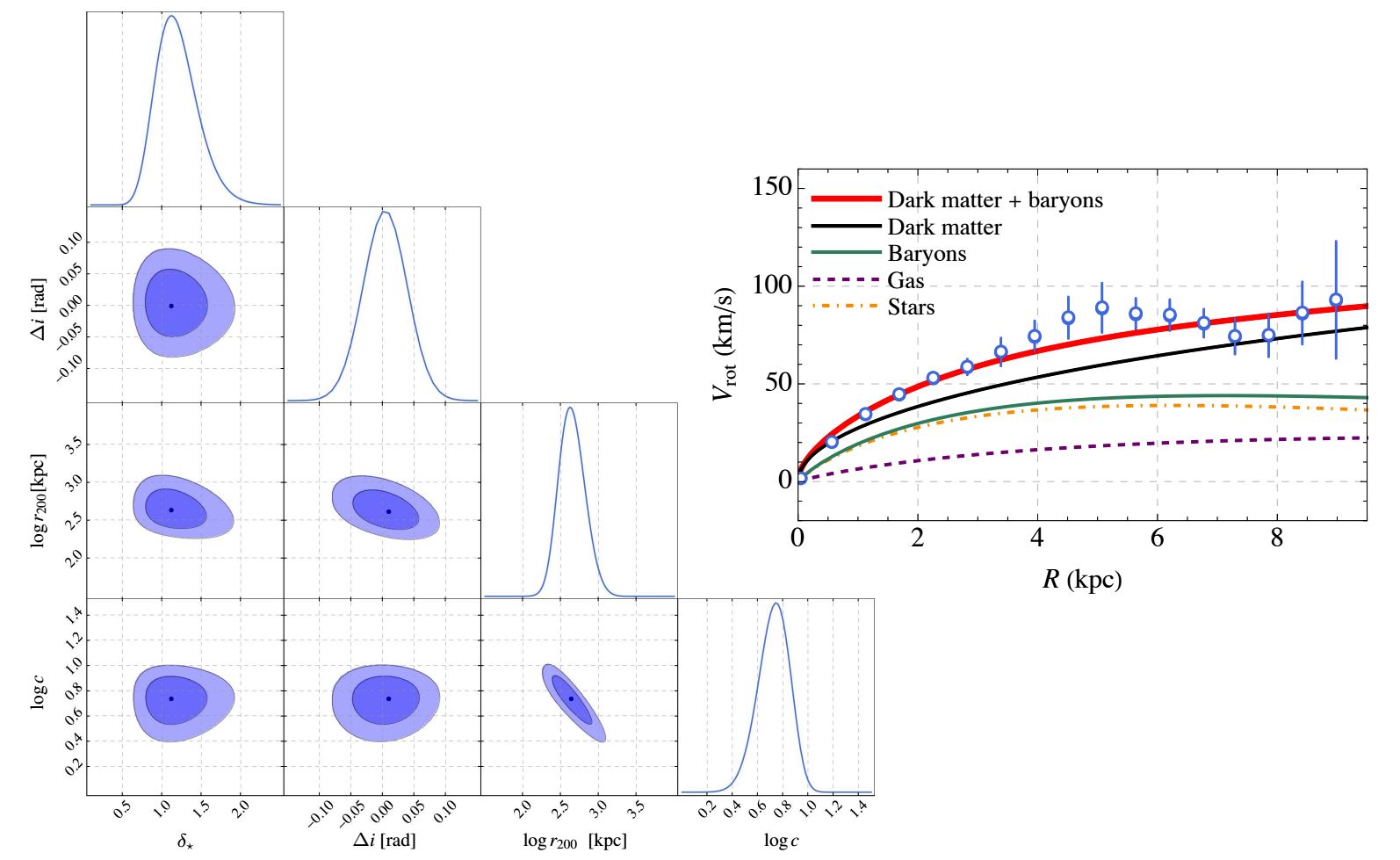
The analysis of the structure and dynamics of the galaxy closest to the explosion revealed no evidence of recent interactions with other galaxies, deepening the mystery: how could a binary neutron star system end up so far from its place of origin? In response, the researchers tested two main hypotheses.
The first hypothesis considered that the system formed within a globular cluster — a dense group of stars often located far from the center of a galaxy. However, the deep images obtained by the James Webb Space Telescope, sensitive enough to detect typical globular clusters capable of hosting such a system (with less common scenarios having a probability below 0.3%), found no evidence supporting this possibility.
The second hypothesis, more complex and extensively investigated in the study, suggests that the system was ejected after successive stellar explosions. When massive stars collapse and form neutron stars, they can receive “kicks” that propel them at speeds of hundreds of kilometers per second. If the binary system survives these events, it may be expelled from the galactic disk and travel for hundreds of millions of years before eventually merging and producing the kilonova. Although this scenario had already been considered the most plausible, the quantitative analysis — based on a detailed model of the host galaxy combined with advanced simulations of hundreds of thousands of binary systems — showed that only about 0.1% of the simulated cases reproduced the observed conditions. In practice, this makes the explanation nearly as unlikely as the globular cluster formation hypothesis. GRB 230307A therefore represents an extreme case study for understanding the formation, evolution, and collision of compact stars in the universe.
Understanding the origin of this type of event is also essential for guiding future observations. Kilonovas play a central role in so-called multi-messenger astronomy, as they can be detected both by telescopes that observe electromagnetic radiation (in the infrared and visible ranges) and by gravitational-wave detectors. To date, only one kilonova has been simultaneously observed through both types of instruments, in 2017. In the case of the 2023 event, the gravitational-wave detectors LIGO, Virgo, and KAGRA were not operating continuously.
These combined detections are fundamental for advances ranging from the physics of matter under extreme conditions to the understanding of the large-scale dynamics of the universe. The fact that, since 2017, there has been only one robust detection of this kind highlights important gaps in our current understanding of kilonovas and reinforces the need for further studies in this field.